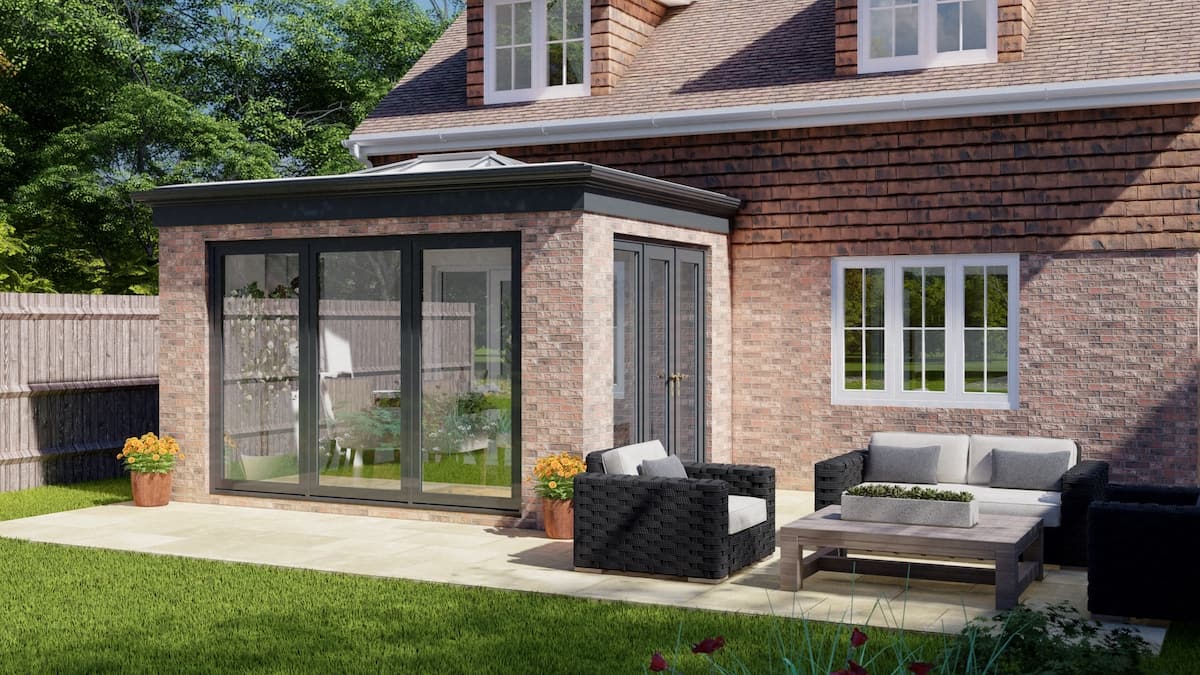
What Is the Difference Between an Orangery and a Conservatory?
What’s the difference?
An orangery and a conservatory are not the same structure. They differ in construction, thermal performance, planning classification, cost, and the way they feel to live in. An orangery is a masonry-integrated, predominantly solid-roofed extension with a central glass lantern, designed to function as a permanent room year-round. A conservatory is a lighter, predominantly glazed structure with a fully glass or polycarbonate roof, originally conceived as an enclosed garden space.
Understanding the distinction matters before committing to either — the right choice depends on how you intend to use the space, your property type, and your budget.
What Is an Orangery?
Historically, orangeries were designed to provide better insulation during cold winters so that owners could grow exotic plants and citrus fruits that would not normally thrive in a colder climate. The brick structure provided insulation while the windows allowed plants to receive natural light.
By the 19th century, orangeries had evolved from functional growing structures into something of a status symbol. Today, a bespoke orangery serves as a versatile, year-round room — a comfortable living space, dining room, kitchen extension or home office, architecturally connected to the main house.
Structurally, an orangery features substantial brick or insulated pillars, a flat solid roof perimeter, and a central glazed roof lantern. The solid roof area typically represents more than 25% of the total roof, which is what distinguishes it from a conservatory under industry classification. The result, from both inside and out, is a proper room rather than a glass enclosure.
What Is a Conservatory?
The traditional conservatory originated in the 18th century but reached its golden age in 19th century England as a purely functional glass structure for growing plants. Development largely halted during the Second World War, and it was not until the 1970s that the Victorian conservatory form re-emerged as the structures most commonly seen today.
Structurally, a conservatory features a fully glazed or polycarbonate pitched roof, predominantly glass walls resting on a low dwarf wall, and minimal solid masonry. The industry classification requires more than 75% of the roof area to be glazed for a structure to be classified as a conservatory. The overall impression is of an enclosed garden — light, transparent, and visually open to the outside.
A conservatory can add from 5–10% to the value of your home, while an orangery, as a more substantial structure, typically adds 10–15% in property value uplift — a relevant consideration in Surrey’s premium property market.
Thermal Performance
Thermal performance is where the orangery significantly outperforms the traditional conservatory — and it is the primary reason why modern orangeries are usable every month of the year while many conservatories are not.
A conservatory’s fully glazed roof makes it highly susceptible to rapid temperature swings. In summer, solar gain through the glass can make the space uncomfortably hot. In winter, heat loss through the same roof makes it cold. Modern glazing technology has improved this considerably, but the physics of a predominantly glass structure work against year-round comfort.
An orangery’s solid roof perimeter, built using a warm deck roofing system, provides a continuous insulated thermal envelope. In a warm deck system, rigid insulation is placed above the structural roof deck, keeping all structural elements within the warm zone of the building and preventing thermal bridging and condensation. The central glass lantern brings natural light into the space without the thermal penalty of a fully glazed roof. The result is a room that stays warm in winter and comfortable in summer.
Surrey Orangery builds all orangeries using warm deck roofing systems as standard, with high-performance glazing options including solar glass to optimise year-round thermal performance.
Side-by-Side Comparison
| Feature | Conservatory | Orangery |
|---|---|---|
| Roof construction | Fully glazed or polycarbonate pitched roof | Solid flat roof perimeter with central glass lantern |
| Wall structure | Predominantly glass on a low dwarf wall | Solid brick or insulated pillars with large glazed windows |
| Thermal performance | Variable — can overheat in summer, lose heat in winter | Superior — warm deck insulation, usable year-round |
| Interior feel | Light, airy, enclosed garden atmosphere | Substantial, room-like, architectural ceiling detail |
| Property value uplift | Typically 5–10% | Typically 10–15% |
| Typical cost range | £15,000 – £35,000 | £30,000 upwards, dependent on size and specification |
Planning Permission
For planning purposes, both orangeries and conservatories are classified as single-storey extensions under the Town and Country Planning (General Permitted Development) (England) Order. Both are subject to the same permitted development rules — meaning planning permission is not required for most residential properties in Surrey, provided the structure meets all of the following criteria:
- The structure does not cover more than 50% of the total land surrounding the original house
- It remains single-storey with a maximum overall height of 4 metres
- It does not extend beyond the rear wall by more than 4 metres for a detached property, or 3 metres for a semi-detached or terraced property
- If within 2 metres of a boundary, the eaves height does not exceed 3 metres
- It does not protrude forward of the principal elevation facing a public highway
However, Surrey has a significant number of conservation areas, Areas of Outstanding Natural Beauty, and properties subject to Article 4 Directions, where permitted development rights are restricted or removed entirely. Listed buildings require separate Listed Building Consent. Surrey Orangery assesses permitted development rights as part of every project and manages planning applications where required.
Regardless of whether planning permission is needed, Surrey Orangery recommends obtaining a Lawful Development Certificate from the relevant local authority — Guildford Borough Council, Elmbridge Borough Council, Mole Valley District Council, or Waverley Borough Council depending on your location. This provides permanent legal documentation that the structure was compliant at point of construction, which is invaluable when selling the property.
Cost Differences
A conservatory is generally less expensive to build than an orangery of equivalent size. The predominantly prefabricated glazed components of a conservatory reduce both material costs and installation time. A standard conservatory in Surrey typically starts from £15,000 to £25,000 for a modest structure, rising to £35,000 or more for larger or higher-specification builds.
An orangery requires more complex construction — masonry pillars, insulated roof structures, warm deck roofing systems, and bespoke glazed lanterns. This is reflected in the cost. However, the orangery also delivers significantly more in return: it adds greater value to the property, performs better thermally, and is appraised by the property market as a genuine habitable room rather than a seasonal addition.
For accurate orangery pricing based on your specific project — size, materials, glazing specification and site requirements — Surrey Orangery provides a free, no-obligation home visit and a detailed written quotation.
Which Is Right for My Surrey Home?
The answer depends on three things: how you intend to use the space, your property type, and your budget.
A conservatory suits homeowners who want maximum natural light and a direct visual connection to the garden, at a lower upfront cost, and who are comfortable with a space that may be more seasonal in character.
An orangery suits homeowners who want a permanent, year-round room that feels architecturally connected to the main house, adds substantial property value, and functions equally well as a kitchen extension, dining room, living space or home office regardless of the season. In Surrey’s property market — where average house prices significantly exceed the national average — the investment case for an orangery over a conservatory is particularly strong.
For period properties, detached homes, and properties in affluent Surrey locations including Guildford, Cobham, Weybridge, Esher and Oxshott, an orangery is almost always the right architectural choice. Its solid masonry construction complements traditional brickwork in a way that a predominantly glass structure rarely achieves.
Frequently Asked Questions
Is an orangery more expensive than a conservatory?
Yes, typically. An orangery involves more complex masonry construction, insulated roofing systems and bespoke glazing, which increases cost relative to a standard conservatory. However, an orangery also adds more value to the property and performs significantly better thermally, making it a stronger long-term investment for most Surrey homeowners.
Does an orangery need planning permission in Surrey?
Most orangeries in Surrey fall under permitted development rights and do not require planning permission, provided they meet the standard dimensional and placement criteria. Properties in conservation areas, AONBs, or subject to Article 4 Directions may require full planning permission. Surrey Orangery assesses this on every project as part of the initial consultation.
Can a conservatory be converted into an orangery?
Yes. Converting an existing conservatory into an orangery typically involves replacing the glazed roof with a solid warm deck roof incorporating a central lantern, upgrading the wall structure where required, and improving the thermal envelope. Surrey Orangery has completed several conservatory-to-orangery conversions across Surrey.
What adds more value — an orangery or a conservatory?
An orangery consistently outperforms a conservatory on property value uplift. A well-built orangery can add 10–15% to a Surrey property’s value. A conservatory typically adds 5–10%, and only when in good condition with quality modern glazing.